
INTRODUCTION
The occurrence of hydrocarbons in igneous and metamorphic rocks is widely recognized and reported in more than 100 countries around the world (Schutter, 2003). Such occurrences have commonly been regarded as evidence of abiogenic generation even if, in recent years it was demonstrated that, abiogenic hydrocarbons formed via Fischer-Tropsch reactions (Anderson et al., 1984) represent only a small proportion of the global budget in known reservoirs (Lollar et al., 2002). In basement reservoirs the source rocks do not necessarily lie beneath (Landes et al., 1960) and hydrocarbons often migrated downwards due to compactional squeezing of source rocks or laterally toward basement fault-bordered highs (Parnell 1988; Muirhead et al., 2017; Holdsworth et al., 2020).
Reservoirs hosted by volcanic rocks are also widespread in geothermal settings where hydrocarbons migrated from nearby source rocks that generated as a consequence of elevated temperature (Peabody, 1993; Schutter, 2003) or by the interaction of organic-rich rocks with hydrothermal fluids (Clifton et al., 1990; Schoell et al., 1990; Simoneit, 1990; Yamanaka et al., 2000; Venkatesan et al., 2003; Zárate-Del Valle & Simoneit, 2005; Zárate-Del Valle et al., 2006; Gurgey et al., 2007; Simoneit et al., 2009; Kontorovich et al., 2011). This phenomenon is often overlooked or underestimated in the geological record due to HC dispersion and/or migration (Parnell, 1988) or because of limited generation. In these cases it can be recognized by the occurrence of oil or degraded oil (i.e. bitumen) in fractures and/or mineralized veins. In veins, non-degraded oil can be generally recognized as UV-fluorescing inclusions in quartz and calcite, while common modes of occurrence of bitumen are as nodules, as thin films along vein margins or around crystals, within vugs in breccia veins and fine disseminations within siliceous sinters (Peabody, 1993; Lindgren & Parnell, 2006). The importance of recognizing the generation and migration of petroleum residues and/or bitumen in hydrothermal areas is mainly because of their role in the uptake or reduction of metals during interaction with hydrothermal fluids to form ore deposits (Parnell, 1993).
Some of the most important ore mineralization in Italy is hosted in Southern Tuscany (Dessau et al., 1972), in particular in the Monte Amiata region (Brogi et al., 2011; Morteani et al., 2011; 2017; Rimondi et al., 2015), in the area of Boccheggiano (Liotta et al., 2010; Rossetti et al., 2011), in Gavorrano (Brogi et alli, 2021) and in the Tafone Basin (Armiento et al., 2017). Mineralization is linked to the intense hydrothermal activity associated with Plio-Quaternary volcanism at the Tyrrenian margin. Monte Amiata has been a major mercury producer until about thirty years ago (Brogi et al., 2011), being cited among the six most productive mines in the world (Brobst, 1973). The Boccheggiano area has also a long history of exploitation for pyrite, base metals and silver production, and important sulphide mineralization is recognized along the Pliocene Bocchaggiano Fault (Liotta et al., 2010), while the Tafone Basin has been known as a mining district for sulphide epithermal minerals (stibnite and pyrite) since Etruscan times (VII-III centuries BC, Cipriani & Tanelli, 1983).
Throughout the area, the presence of hydrocarbons associated with mineralization has been noted by many authors (Arisi Rota & Vighi, 1971; Klemm & Neumann, 1984; Peabody, 1993; Rimondi et al., 2015; Biagioni et al., 2017; Morteani et al., 2017). These authors focus in particular on the presence of methane from gas emissions in the Mt. Amiata, Larderello, Manziana and Latera geothermal systems (Peabody, 1993; Morteani et al., 2011; Tassi et al., 2012) and with heavy hydrocarbon occurrences in the deposits of Bagnore (SW of Mt. Amiata, Arisi Rota & Vighi, 1971; Klemm & Neumann, 1984; Rimondi et al., 2015; Biagioni et al., 2017). Even if most of the methane in the geothermal systems is thought to be abiogenic (Tassi et al., 2012), the origin of the heavy hydrocarbon is still unknown and has not yet been investigated in detail (Rimondi et al., 2015).
In this work we report for the first time evidence of hydrocarbons in the metamorphic rocks of Monti Romani at the footwall of the Tafone Basin, in Southern Tuscany, and attempt an understanding of the possible genesis, migration and degradation and the implications for ore deposits in similar areas.
GEOLOGICAL SETTING
The exhumed metamorphic units of the inner Northern Appennines cropping out in the area of Monti Romani is the focus of this study (Fig. 1a). The Northern Appennine fold and thrust belt formed as a consequence of the convergence between the Corsica-Sardinia block (European plate) and the Adria promontory (Adriatic plate) during the Late Miocene (Jolivet et al., 1998; Molli, 2008; Barchi, 2010). This process led to the stacking of units from different paleogeographic domains (i.e. Ligurian oceanic domain, Tuscan epicontinental domain). In the Tuscan sector of the Northern Appennine the Paleozoic metamorphosed units are overthrusted by the non-metamorphosed carbonate succession of the Tuscan Domain, which is in turn overthrusted by the allochthonous Ligurian Units that represent the uppermost tectonostratigraphic unit of the northern Apennines (Brogi & Giorgetti, 2012). All of these units are unconformably covered by post-orogenic lower Miocene lacustrine and delta deposits (Cornamusini et al., 2011) and by Plio-Pleistocene marine and alluvial deposits. The exhumation of the metamorphic units is associated with a strong lithospheric thinning during Late Oligocene-Miocene extensional tectonics (Jolivet et al., 1998; Barchi, 2010). Since the Plio-Quaternary they were subjected to back-arc extension, with limited magmatism (Fig. 1a), there and along the whole Tyrrenian margin (Acocella & Funiciello, 2006).
- a) Metamorphic and volcanic outcrops in the Tuscan Tyrrenian margin; b) Geological map of the studied area showing sample location, mines location and section of geological profile; c) geological profile across the Tafone Graben. Geological map derived from Cornamusini et al. (2011) redrawn using the online database of Regione Toscana: http://www502.regione.toscana.it/geoscopio/geologia.html.
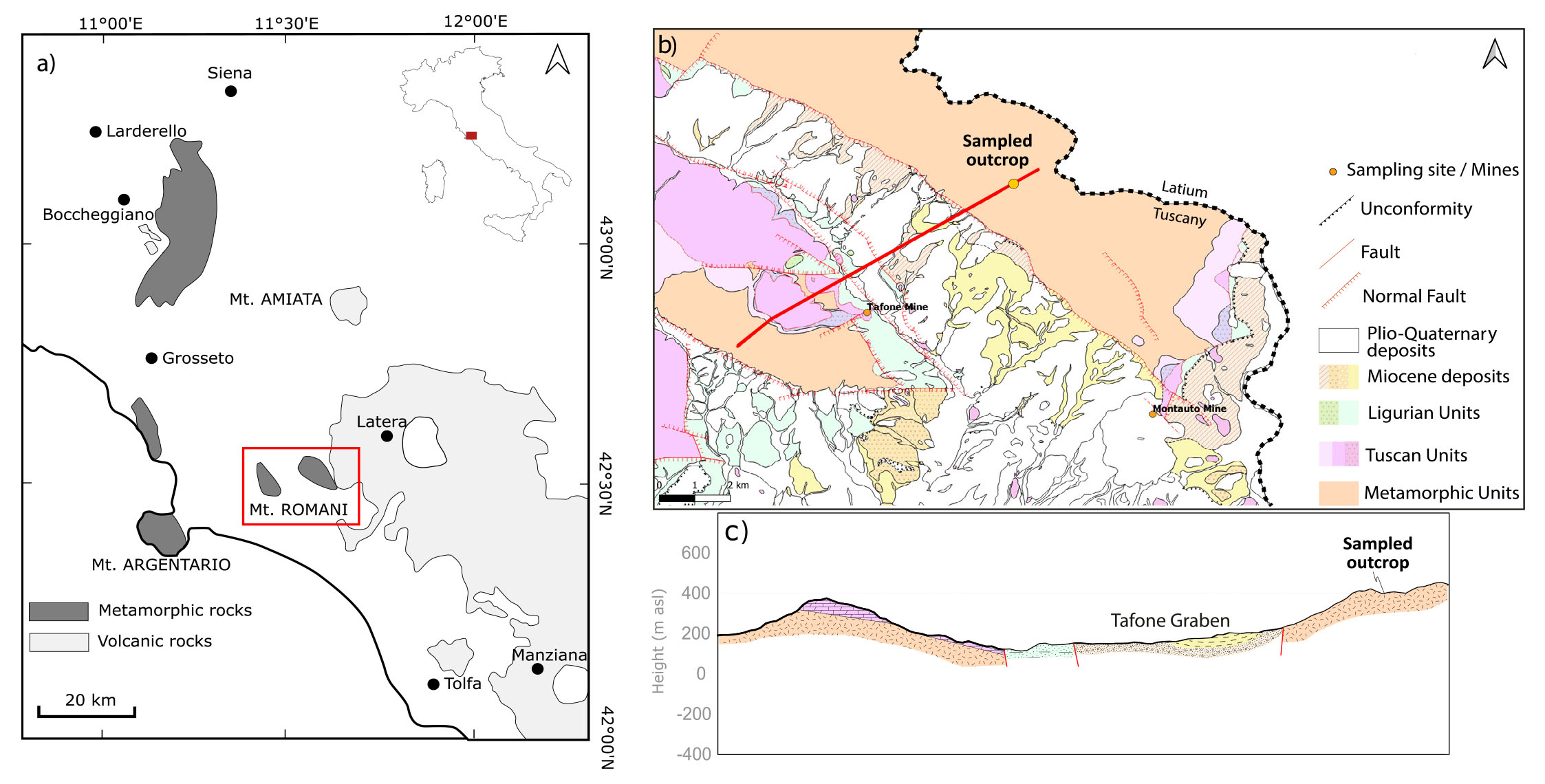
The studied area is located at the south-western border between Tuscany and Latium (Fig. 1a and b). In this locality, Roccaccia di Monteauto Fillades recently dated as Guadalupian by Molli et al., (2020), are mainly composed of dark metapelites and metarenites, which crop out on both flanks of the Tafone Graben and are overlain in tectonic contact (Brogi, 2008) by the dolomitic limestones of the Calcare Cavernoso Formation. The Tafone Graben infill is made up, from younger to older, by Plio-Pleistocene lacustrine sediments that lie unconformably on lower Miocene sandstones, conglomerates and shales that in turn unconformably cover the Ligurian and Tuscan Units (Fig. 1c, Moretti et al., 1990; Cornamusini et al., 2011). The thickness of the sediments above the Ligurian units never exceeds 200 m in the graben (Cornamusini et al., 2011).
Since the Miocene, the area experienced brittle tectonic deformation linked to extension and associated volcanism of the Tyrrenian margin that led to the formation of the NW-SE faults that border the Tafone Graben and associated fractures and veins. Moreover, geothermal activity due to underlying magmatic bodies led to geothermal fluid circulation along the faults that border the graben. This activity is manifested as springs depositing travertine and epitheral stibnite and cinnabar mineralization (Morteani et al., 2011) in two abandoned mines in the area (Tafone and Monteauto mines, Fig. 1b).
MATERIALS AND METHODS
Materials
Six samples for organic geochemical and spectroscopic analyses on organic matter and four samples for fluid inclusions and petrographic observation on quartz were collected from an outcrop in Roccaccia di Montauto locality (N 42°39’46,2’’ - E 11°35’56,5’’; Figs. 1 and 2). Samples collected for geochemical analyses are composed of dark metapelites intensely defomed with a schistosity defined by the axial plane of isoclinal folds and a crenulation cleavage with a roughly NNW-SSE direction (black dotted lines in Fig. 2a). Brittle deformation is characterized by NW-SE faults (red dotted lines in Fig. 2a) and fractures.
- a) Photo of the sampled outcrop with normal faults highlighted with red-dotted lines and schistosity with black-dotted lines. Hammer length is 33 cm. Red dots indicates samples used for the analyses of the organic fraction (Raman and GC-MS) while white squares the location of veins for fluid inclusions analyses. b) Enlarged view of the black rectangle in Fig. a showing the quartz vein (black-dotted line) at the core of the fold. Pencil length is about 18 cm. c) The hinge of the fold in Fig. 2b is characterized by a dark film composed of carbonaceous material; d) Raman spectrum of graphitic carbon in the rocks (sample S15); e) Raman spectrum of disordered carbonaceous material that composed the dark film in Fig. 2c (Samples S15F). Raman bands in Fig. d are named after Beyssac et al. (2002), while in Fig. e after Schito et al. (2017).
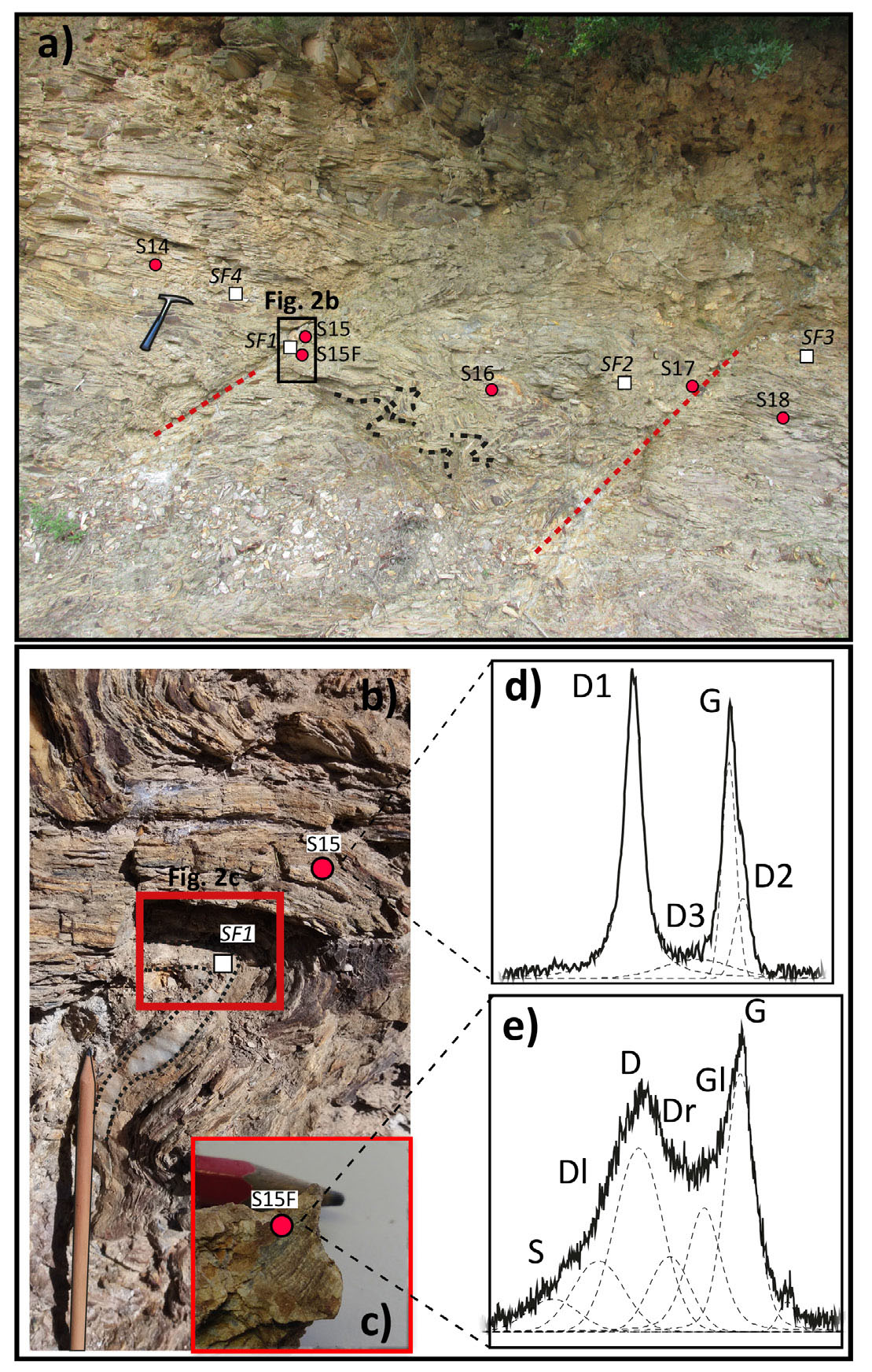
The sampling strategy was to analyze organic-rich metapelites and quartz mineralization on a transect across the outcrop (Fig. 2a).
Figure 2b show an example of a vein samples for fluid inclusions analyses where the contact between quartz and pelites at the hinge of the fold is characterized by a dark film composed by carbonaceous material (Sample S15F).
Methods
Raman spectroscopy
Micro-Raman spectroscopy was carried out on metapelites cut perpendicular to the main foliation or perpendicular to the contact between the vein and the rock in sample S15F (see Fig. 2).
A Neodimium-Yag laser at 532 nm (green laser) in a backscattering geometry using a 600 grooves/mm spectrometer gratings and CCD detector was used. The instrument is equipped with 50× and 100× objective lens with a laser spot of about 2 μm diameter. An excitation wavelength of 532 nm with a power of 40 mW from an Ar+ laser was reduced up to 0.4 mW by using optical filters to avoid carbon overheating. Raman backscattered radiation was recorded for an integration time of 20s for 6 repetitions in a range between 700 and 2300 cm-1. Depending on the spectra, Raman parameters were calculated by means of a four bands deconvolution suggested by Beyssac et al. (2002) for graphitic carbon or by the six bands deconvolution proposed by Schito et al. (2017) for diagenetic organic matter (Figs. 2d and e). Bands deconvolution was performed using LabSpec software by Horiba (Schito et al., 2017).
Fluid inclusion homogenization temperatures
Fluid inclusion analyses were performed on quartz veins as shown in Fig. 2a and c (samples SF1, SF2, SF3 and SF4). Samples were prepared as 200 μm thick, doubly polished sections, then observed with a polarized microscope to define types of fluid inclusions and their genetic relationships. The homogenization temperatures of fluid inclusions were measured using a THMS-600 heating–freezing stage mounted on a Nikon Labophot transmission light microscope at the University of Aberdeen. The instrument is equipped with a range of objective lenses ranging from 20× to a 100× lens and was calibrated against synthetic H2O (374.1 and 0.0 °C) and CO2 (−56.6 °C) standards (Synthetic Fluid Inclusion Reference Set, Bubbles Inc., USA). The homogenization of aqueous two-phase inclusions was taken to indicate the temperatures at which the host mineral phase precipitated.
Gas Chromatography Mass Spectroscopy (GC-MS) analysis of biomarkers
Samples were solvent extracted using Soxhlet apparatus (about 10 g of rock was extracted in dichloromethane/methanol 93:7 v/v for 48 h). The extract was fractionated using flash mini-column chromatography (silica column; hexane for saturated fraction; 3:1 v/v hexane/dichloromethane for aromatics fraction; 2:1 v/v dichloromethane/methane for polar fraction). The resulting saturate fraction was analyzed by gas chromatography-mass spectrometry (GC-MS). GC-MS was per-formed using a 6890N Network GC system interfaced to a 5975 inert mass selective detector. A spliteless injector (300°C) mode was used, and the GC temperature program was as follows; 60°C to 120°C at 20°Cmin−1 then from 120°C to 290°C at 4°Cmin−1. The column was Greyhound GC-5 (an HP-5 equivalent phase; 30 m length, 250 μm ID and 0.25 μm film thickness). The MS was operated in sim mode (less than 20 ions with a dwell time less than 40 ms).
RESULTS
Organic matter petrography and Raman Spectroscopy
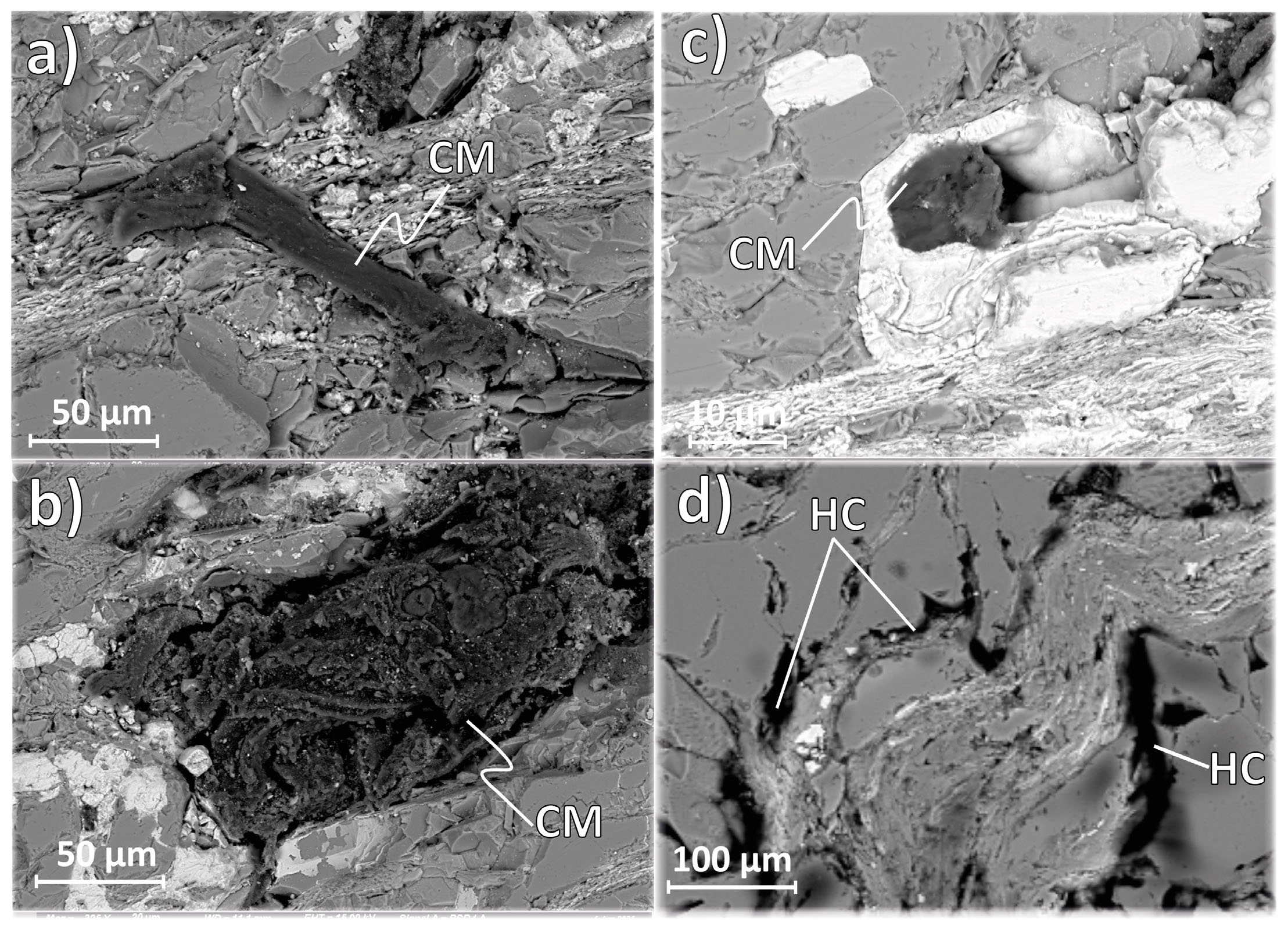
Metapelites in southern Tuscany are characterized by a relatively high content in carbonaceous material that, in the area of Mte. Amiata, has been estimated to be 0.7% (Elter & Pandeli, 1991; Orlando et al., 2010). At the macroscale, graphitic carbon grows parallel to schistosity (Fig. 2b and d) while amorphous carbon occurs as dark films (Fig. 2c and e). At the microscale, thin sections show amorphous carbon generally occurs as nodules. Detailed SEM observations at the margin of quartz veins reveal that carbonaceous material occurs as: i) elongated fragments growing in clay-rich layers parallel to the foliation (Fig. 3a); ii) fractures or void-filling solid material (Fig. 3b and c) and iii) liquid hydrocarbons around quartz grains (Fig. 3d). Interestingly type ii and iii CM occur only just at the contact or inside the quartz veins.
- Back-scattered SEM images of carbonaceous material in the form of elongated fragments with smoothed surfaces (a); fracture filling solid material with some probable biological structures (b); hematite void filled by organic matter (c); liquid hydrocarbons around quartz grains (d). See materials section for more informations. CM – carbonaceous material; HC – hydrocarbons.
Raman spectra of graphitic carbon are characterized by broad D and G bands, respectively at 1350 and 1600 cm-1 (Fig. 2d). The G band peak has an asymmetric shape due to the presence of the D2 band at about 1620 cm-1 and has similar intensities to the D band (Fig. 3b). A fourth broad band (D3 according to Beyssac et al., 2002) lies in between the D and the G bands. In order to calculate maximum temperatures from Raman spectra, R2 parameter and paleotemperatures were calculated for each sample, according to Beyssac et al. (2002), showing values between about 370 and 405 °C (Table 1).
| Graphitic Carbon | ||||||||
| Sample | G band position | s.d. | FWMH-G | s.d. | R2 | s.d. | T°C | s.d. |
| S14 | 1588.63 | 1.77 | 32.70 | 2.04 | 0.55 | 0.02 | 396.38 | 10.21 |
| S15 | 1583.84 | 2.38 | 29.20 | 1.60 | 0.60 | 0.03 | 374.12 | 12.42 |
| S16 | 1593.48 | 2.80 | 36.10 | 2.07 | 0.59 | 0.03 | 379.86 | 11.40 |
| S17 | 1589.03 | 1.17 | 34.40 | 1.31 | 0.53 | 0.02 | 403.44 | 9.01 |
| S18 | 1588.64 | 1.54 | 46.80 | 4.30 | 0.61 | 0.02 | 369.69 | 9.50 |
| Disordered Carbon | ||||||||
| S15F | 1609.35 | 9.56 | 81.64 | 14.31 | - | - | - | - |
| S17 | 1606.20 | 7.75 | 81.05 | 8.01 | - | - | - | - |
Amorphous carbon was found only in samples S15F and S17 with a spectrum composed by six first order bands between 1100 and 1700 cm-1 (Fig. 2e) and a broad signal in the second order Raman spectrum between 2650 and 2950 cm-1. The first order spectrum is the result of the overlapping of several bands. The main bands are the D and G peaks, respectively at 1350 and 1600 cm-1. The ̴1600 cm-1 graphite peak is a composite of several Raman bands at ̴1615 cm-1 and ̴1598 cm-1 that cannot be separated in poorly organised carbon or low-grade rocks (Beyssac et al., 2002), such as those in this study. A further band at 1540 cm-1 (Gl) contributes a left shoulder to the G band while a very small band occurs at 1700 cm-1 (Fig. 3d). The D band is bordered by two bands at around 1250 and 1500 cm-1 (Dr and Dl according to Li, 2007) while a further band is found at a lower wavelength (S band at 1150 cm-1; Li, 2007; Deldicque et al., 2016; Ferralis et al., 2016; Schito et al., 2017; Nirrengarten et al., 2020). The main differences with graphitic carbon are evident by comparing the position and full width at maximum height (FWMH) of the G band (Tab. 1). In amorphous carbon the G band lies between 1606 and 1609 cm-1 with a FWMH of more than 80 cm-1 while it is closer to the graphite position at 1580 cm-1 and has a narrower FWMH in metamorphic organic matter (Tab. 1).
Moreover, Raman spectroscopy outline that, in all samples some black material (probably carbonaceous material) was recognized, but with a Raman spectrum totally overwhelmed by fluorescence (i.e., high hydrogen).
Gas-Chromatography Mass Spectrometry (GC-MS)
All samples and extracts contain a mixtures of recent and fossil (petroleum-like) organic matter (e.g. hydrocarbons from living organic matter as well as hydrocarbons found in petroleum). Both isoprenoid as well as lower carbon number n-alkanes (i.e. C16 to C22) are the main constituents resolvable on the m/z 85 ion chromatograms of the hydrocarbon fractions. Where they are evident on chromatograms, high carbon n-alkanes have a strong odd over even preference indicating a mixture of surface biology (likely mosses or other endoliths – Pancost et al., 2002) and petroleum n-alkanes. There are sufficient odd n-alkanes that they are unlikely to be attributable to biological sources alone (see Parnell et al., 2008 for an example of naturally mixed petroleum and biological organic matter).
Similarly, triterpenoid and pentacyclic-terpenoid biomarkers also evidence inputs of both recent and fossil hopanoids, with many samples having diploptene as the main terpenopid (diploptene is a biomolecule not stable in the geological record, but biosynthesied by both mosses and prokaryotes, Prahl et al., 1992). However, some samples have a m/z 191 chromatogram far more typical of petroleum, in which diploptene is present in only very small amounts, with sample S15 exhibiting the distribution of hopanes most typical of geological samples. No samples contain high abundances of preoil window hopanoids, e.g. 17,21 β,β hopanes and neohop-17(21)- enes are not present; they evidence only directly biosynthesised hopanoids, or hopanoids found in oil produced during catagenesis. 25-Norhopanes are present in all samples, but are most clearly developed in sample S15, in terms of the presence of a range of carbon number homologues (up to 30) found in the regular hopanes (177 m/z ion chromatograms for hopanes and mass spectra for C29 17α 25-norhopane shown in Fig. 4).
- a) Ion chromatograms for m/z 191 and 177 for sample S15 showing identification of hopanes and norhopanes; b) Ion chromatograms for m/z 191, 189, 412 and 205 for sample S15 showing identification of hopanes and methylhopanes, diploptene, gammacerane; c) C29 17α 25-norhopane mass spectra at 46.312 min.
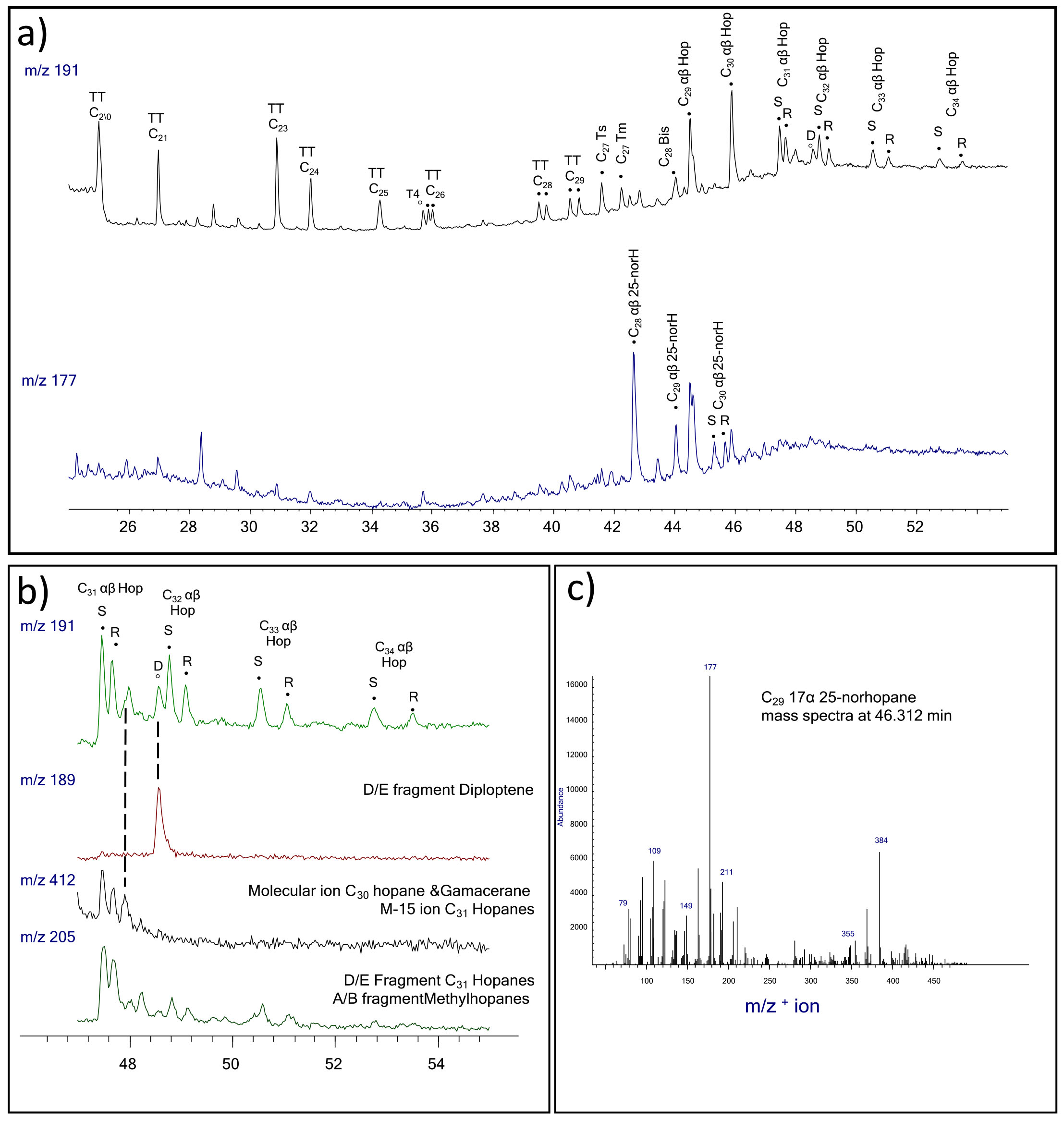
The 25-norhopanes derive from the demethylation of regular hopanoids during biodegradation under subsurface conditions (Bennett et al., 2006). Although biodegradation does make petroleum viscous by removing lighter hydrocarbons (Connan, 1984), the mixing of light and heavier charges of oil means that oil containing biodegradation products can still be mobilised in the subsurface (Parnell et al., 2017; Al-Hajeri & Bowden, 2018).
Steranes could also be detected in all samples but, relative to the hopanoids, characteristics indicative of biodegradation are not as clear; for example diasteranes and C29 regular steranes are not selectively enriched to a significant extent, which has been shown to happen during biodegradation at surface and near conditions (see Parnell et al., 2017, for a case of biodegraded oil within basement rocks). Nevertheless, it has be found by Brooks et al. (1998) and Bost et al. (2001) that steranes and hopanes degradation don’t follow the same biochemical pathway but are results of a complex interplay of multiple microbial reactions. As a consequence the presence of both evidences of steranes and hopanes biodegradation is rare in most of altered oils (Peters et al., 2005).
A ternary plot of carbon number homologues is presented in Figure 5 c, and a small variation between samples is evident, but the samples cluster in the same region indicating they are from the same source.
- a) Ion chromatograms for m/z 217 for sample S17 showing identification of diasterane and sterane; b) 20S sterane vs αββ/ααα+βββ maturity diagram; c) ternary C27,C28,C29 diagram; d) 22 hopane vs Ts/Ts+Tm maturity diagram.
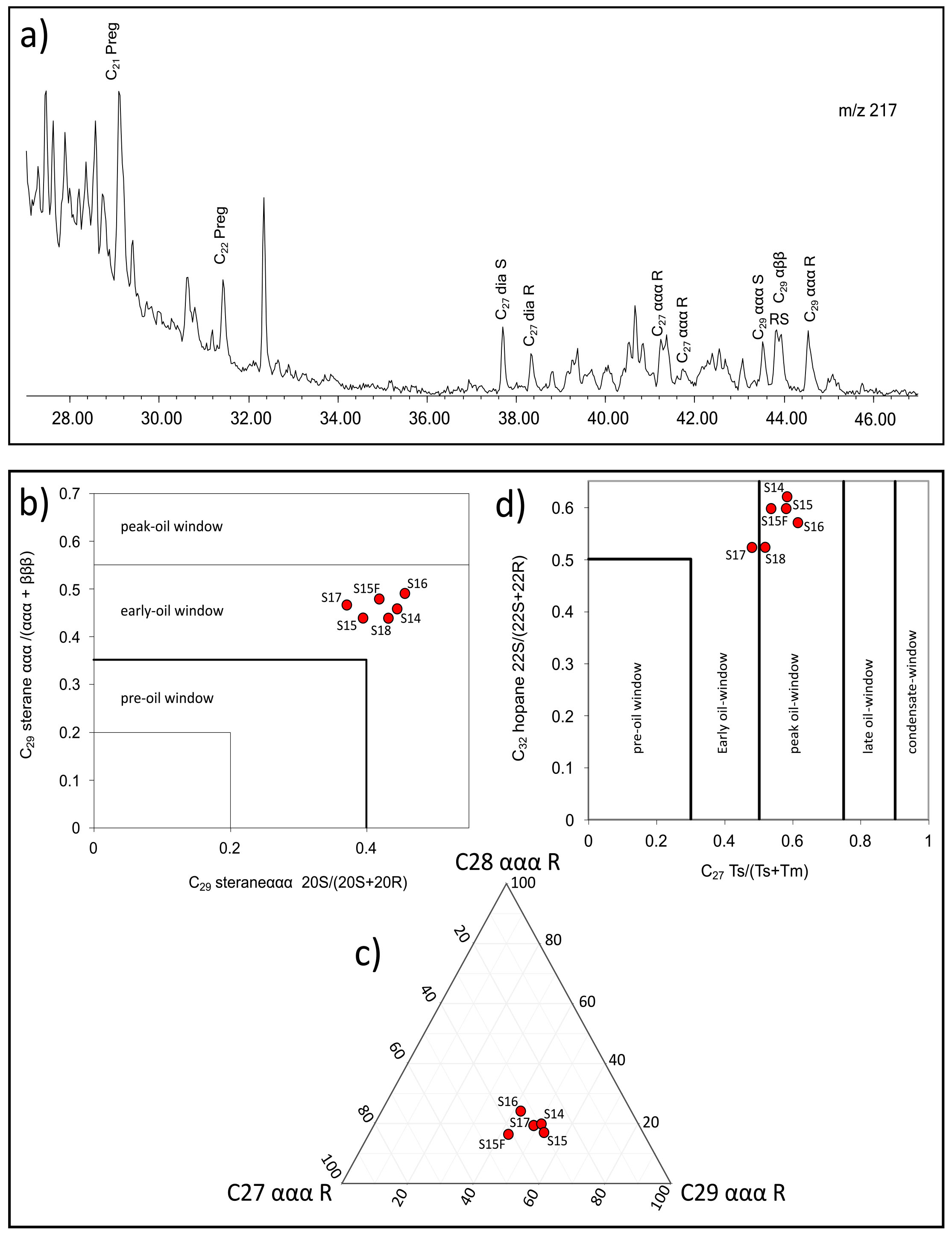
In combination, the biomarker parameters indicate a relatively low thermal maturity. The sterane ratio indicate an early oil window thermal maturity, whereas hopane ratio indicate a slightly higher thermal maturity (Fig. 5b and d). This is a relatively mild thermal maturity, particularly compared to the host rock, and in a classical source rock context would equate to a vitrinite reflectance of ~ 0.8 %Vr (based on comparison chart in Killops & Killops, 2005).
Fluid inclusions and Cathodoluminescence
Quartz was sampled from centimetre-scale veins folded with a NE-verging direction. CL observations show that all samples are pervasively cut by a younger generation of quartz characterized by bright CL colours (Figs. 6b,c and d) and often by syntaxial growth (Fig. 6b and c). Such features are present in all samples but are more pervasive in samples SF3 and SF4.
- a) Homogenization temperature histograms from fluid inclusion analyses of samples SF1, SF2, SF3 and SF4. White and grey bins indicate respectively type 1 and type 2 inclusions b) CL image showing the relationship between young quartz (brightest) into old quartz represented by the dark background. c) Close-up of the inset of image b showing the syntaxial growth of the vein with different CL brightness, indicating different stages of mineralization. d) CL image showing the relationship between young quartz (brightest) into old quartz represented by the dark background. e) sketch showing different fluid inclusion populations in quartz.
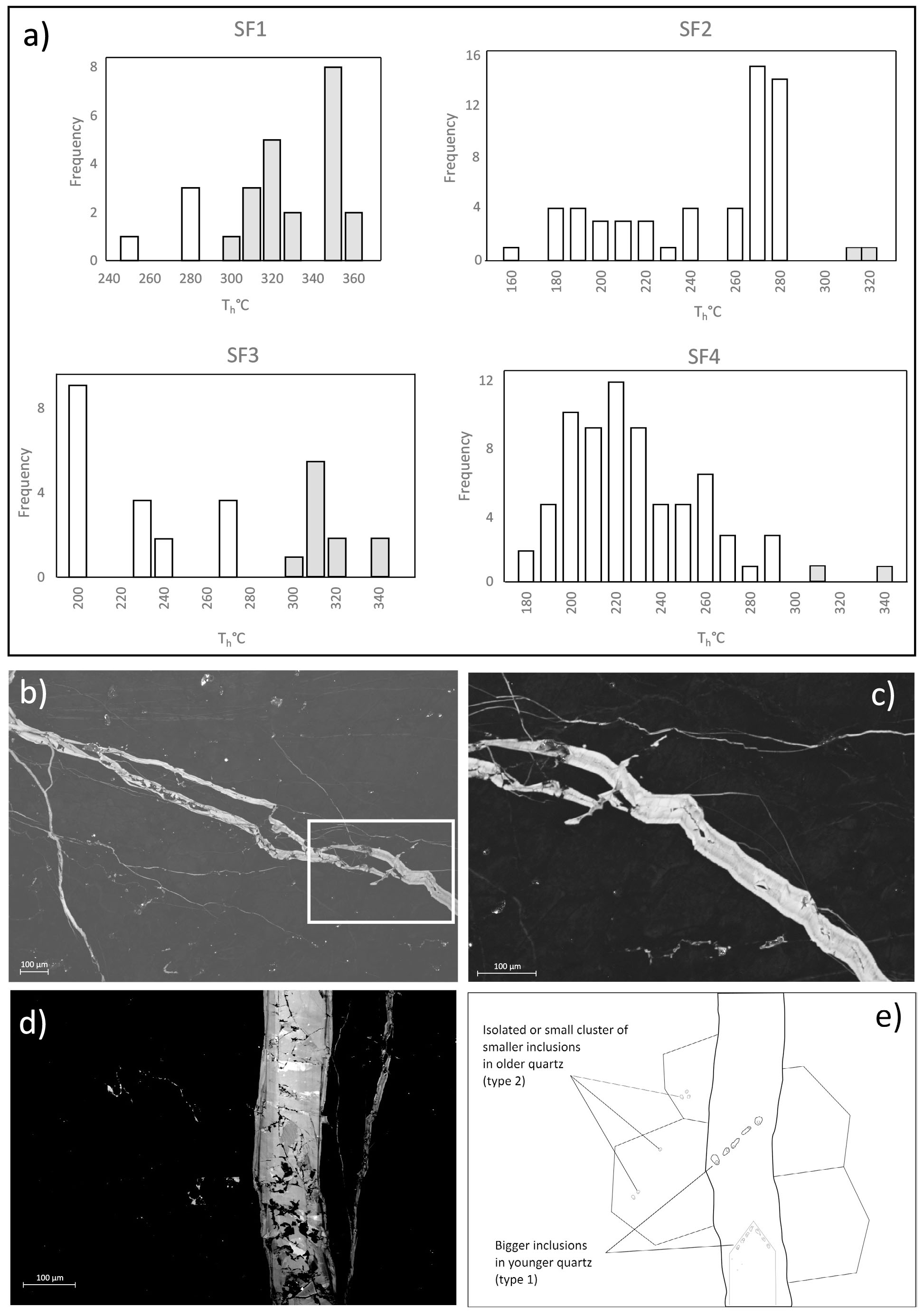
The petrographic characteristics and homogenization temperatures of different fluid inclusion populations reflects different quartz generations. Inclusions in the younger quartz generation (Type 1 inclusion in Table 3 and Fig. 6a and e) are bigger and occur as trails or along the edge of new crystals (Fig. 6e). Homogenization temperatures vary between 200 and 280°C (Table 3). TH for each samples are plotted on histograms in Fig. 6a. Fluid inclusions in quartz minerals outside the youngest veins (Type 2 inclusions Tab. 3 and Fig. 6a and e) occurr as isolated clusters of two phases (aqueous liquid + vapour) with dimensions generally less than 10 μm. Their homogenization temperatures (TH) are consistently above 300 °C.
DISCUSSION
Characterization of carbon material and fluids temperatures
Metapelites from the basement rocks of Monti Romani, in southern Tuscany, are known to be rich in organic matter that has been previously considered to be present in the form of graphitic carbon (Moretti et al., 1990; Elter & Pandeli, 1991). Nevertheless, detailed observations show that the carbonaceous materials exhibit different textures (Fig. 3) and different structural ordering and composition, as revealed by Raman spectroscopy (Fig. 2 ad Tab. 1) and GC-MS analyses (Figs. 4 and 5 and Tab. 2).
| measured on m/z 191 | measured on m/z 217 | |||||||||||||
|---|---|---|---|---|---|---|---|---|---|---|---|---|---|---|
| Sample | EOM (μg g−1) | %Sats | %Arom | %Polar | TT C23/C30Hop | C29 Hop/C28 25-norHop | C30 Hop/Dip | Hop 22S | Ts/Ts+Tm | Ster 20S | αββ/ααα+αββ | C27 αααR | C28 αααR | C29 αααR |
| S15 | 0.15 | 1.2 | 1.2 | 97.6 | 0.63 | 0.98 | 2.91 | 0.60 | 0.58 | 0.40 | 0.44 | 0.30 | 0.18 | 0.52 |
| S15F | 0.65 | 17.6 | 5.9 | 76.5 | 0.91 | 0.00 | 1.95 | 0.60 | 0.53 | 0.42 | 0.48 | 0.41 | 0.16 | 0.42 |
| S14 | 0.05 | 50.0 | 25.0 | 25.0 | 0.84 | 3.62 | 2.24 | 0.62 | 0.58 | 0.45 | 0.46 | 0.31 | 0.18 | 0.51 |
| S16 | 0.06 | 66.7 | 16.7 | 16.7 | 0.77 | 4.42 | 2.44 | 0.57 | 0.62 | 0.46 | 0.49 | 0.34 | 0.24 | 0.42 |
| S17 | 0.18 | 16.7 | 16.7 | 66.7 | 0.86 | 6.54 | 1.86 | 0.52 | 0.48 | 0.37 | 0.47 | 0.31 | 0.19 | 0.50 |
| S18 | 0.09 | 10.0 | 80.0 | 10.0 | 0.56 | 6.65 | 1.67 | 0.52 | 0.52 | 0.43 | 0.44 | 0.32 | 0.19 | 0.49 |
Graphitic carbon occurs in clay-rich bands and its Raman temperatures range between 370 and 405°C comparable with greenschist metamorphic facies, attained during prograde metamorphism in the Alpine orogenesis (Funiciello et al., 1984). Amorphous (disordered) carbon was detected in samples S15F and S17 in the form of dark films and nodules (Figs. 2c and 3c), suggesting fluid mobilization and redeposition (Lindgren & Parnell, 2006). Raman spectral parameters like the FWMH-G or the G band position suggest low maturity rank (i.e. diagenesis, Table 1). Nevertheless, some features such as the high intensity of bands in the “saddle” (i.e. Dr and Gl bands) between D and G bands together with the presence of bands in the second order, are not common in diagenetic spectra and can be found only in amorphous carbon matured under very fast heating rates as found near intrusions (Muirhead et al., 2017), in charcoals (Deldicque et al., 2016), in industrial black carbon (diesel soot, Sadezky et al., 2005) or in solid bitumen collected from mineralized hydrothermal veins (Jehlička et al., 2003; Sokol et al., 2014). Of these possibilities, the presence of solid bitumen is more likely in this case, given that GC-MS analyses highlight the presence of biodegraded hydrocarbons. Biodegradation removes lighter hydrocarbons, leaving high viscosity oils (i.e. bitumen) but with still the potential to migrate along fractures towards the surface.
A third group of carbon material in which the amorphous carbon spectrum is overwhelmed by fluorescence was also observed and can be associated to the biological products detected by GC-MS analyses (mosses or other endoliths) or liquid hydrocarbons.
Petrographic and fluid inclusion analyses outline the presence of two phases of quartz generation associated with different homogenization temperatures. The higher homogenization temperatures are interpreted as re-equilibration of metamorphic temperatures probably during retrograde phases and exhumation, while the young quartz generation and relative low TH temperatures more likely relate to the recent phases of hydrothermal activity. Given that hydrothermal fluids start to circulate after the uplift of the area, TH can be considered as representative of the fluids temperatures whitouth any pressure correction. This range of temperatures is similar to those found by other authors in similar hydrothermal setting in nearby areas in Southern Tuscany (e.g. Boccheggiano fault - Liotta et al., 2010; Rossetti et al., 2011; Amiata - Brogi et al., 2011).
A model for generation and migration of hydrocarbons
GC-MS, Raman and optical analyses, demonstrate the presence of migrated hydrocarbons into the basement rocks, despite there being no productive source rocks known in the area or nearby. Organic carbon in the closest metapelites is in the anthracitic stage with no hydrocarbon potential, while the main source rocks in the Northern Appennine are located far to the north in the Umbria-Marche domain (Oppo et al., 2013). In Tuscany the only occurrence of light hydrocarbon (methane) is known from a lignite level in the Ribolla Basin (Bencini et al., 2012). More in general, upper Tortonian lignites are known to be present in most of the neogenic basin in Southern Tuscany (i.e., Ribolla, Baccinello, Radicofani and Albegna basins, Staccioli et al., 2001; Bossio et al., 2003; Pascucci et al., 2006; Bencini et al., 2012; Cirilli et al., 2016). They generally occur at shallow depth overlaid by few hundred of meters of Plio-quaternary cover and only in the Ribolla basin the condition for hydrocarbon generation were met with a relatively high burial (~ 1000 m) and an extremely high heat flow due to the clonesess to the geothermal Larderello field (Bencini et al., 2012). Nevertheless, a migration from the Ribolla basin is unlikely given the distance (more than 50 km) and the thermal maturity in the oil window depicted by hopanes and steranes ratios in our samples (Figs. 5b and d).
GC-MS analyses show that hydrocarbons are present in all samples across the studied outcrop, with the highest concentration (higher EOM in Table 3) and the only evidence in Raman analyses of amorphous carbon, in samples S15, S15F and S17, that are located along extensional structural elements (Fig. 2a). Fractures and faults related to the post-orogenic extension that started in the middle-late Miocene (Berardi et al., 2016) and led to the opening of the Tafone Basin, were thus probably a preferential path for hydrocarbon migration. Furthermore, the same structural elements were the carriers of the intense hydrothermal circulation developed as a consequence of the emplacement at shallow depth of magmatic products belonging to the Tuscan Magmatic Province (Dini et al., 2005; Rossetti et al., 2008; Morteani et al., 2011, 2017). The association between quartz mineralization and carbon material (Fig. 3) suggest a role of the fluids in the transport, maturation and likely genesis of the hydrocarbons. During their path toward the surface the hot fluids could have reacted with the immature organic matter of the late organic rich sediments, probably the Tortonian-early Messinian (Cornamusini et al., 2011), or at least the Santa Croce Unit (see discussion below), to hydrothermally generate hydrocarbons. Hydrothermal generation is known to occurr as a consequence of the interaction between organic matter with high temperature fluids and has been widely documented, both near oceanic spreading centers (Simoneit, 1990) and in continental rift systems (Zárate-Del Valle & Simoneit, 2005). Formation and migration of hydrothermal petroleum is known to occur rapidly (days-years), in a higher temperature range than conventional oils (from about 60 °C to more than 400 °C) and from source rocks with high to very low TOC content (Peter et al., 1991; Simoneit, 1994). Considering the fluid inclusion homogeneization temperatures (180-280 °C, Fig. 6a), it is reasonable that generation could have occurred in a short-time (years) of repeated hydrothermal pulses that have imparted sufficient energy to drive isomerisaton reactions of an immature kerogen (Tsang et al., 2020) and led to the measured thermal maturity (i.e. oil window; Fig. 5b and d and Tab. 3).
| Samples | TH (°C) Type 1H | TH (°C) Type 2H |
|---|---|---|
| SF1 | 276 | 338 |
| SF2 | 211 | 317 |
| SF3 | 240 | 321 |
| SF4 | 213 | 325 |
Hydrothermal oils share similarities with conventional oils, such as the presence of the full range of n-alkanes, isoprenoid hydrocarbons and biomarkes like mature 17α(H)-hopanes and steranes, while have been reported to differ in the relative abundance of polycyclic aromatic hydrocarbons (PAH) that become dominant for temperatures higher than 350°C (Peter et al., 1991; Simoneit & Kvenvolden, 1994). The occurrence of both liquid and solid (i.e bitumen) hydrocarbons within quartz (Figs. 3b,c and d) associate to Raman spectra that resemble those ones of hydrothermal bitumen (see discussion above) strengthens the hypothesis of a hydrothermal generation.
According to biomarker data in the ternary plot in Figure 5c, all samples seem to cluster in the same region, suggesting an origin from a common source rock composed of a mix of terrestrial and marine organic matter that could agree to the brackish lagoon to shallow marine origin of the late Miocene sediments that fill the Tafone Graben. Given uncertainties linked to the ternary plot of Fig. 5c, a generation from the underneath Santa Croce Unit (Ligurian) cannot be discarded. Nevertheless, Internal Ligurian Units in Tuscany (Rossetti et al., 2011; Marroni et al., 2015) and more in general in the northern Appennine (Corrado et al., 2010; Dellisanti et al., 2010) are known to have suffered deep diagenetic to lowe metamorphic (anchizone) condition and this is not in agreement with hopanes and in particular steranes thermal maturity ratios (Tab. 2). Once generation occurred, given the low permeability in the hanging wall, hydrocarbons probably migrated toward the fractured basement rocks of the footwall (Fig. 7).
- Conceptual model (not to scale) for generation, degradation and migration of hydrocarbons in the Tafone area. The figure shows the path of hydrothermal fluids from the heat source represented by a cooling intrusion. Red colour around the fault indicates hot fluid circulation around the fault that could generate hydrocarbons when in contact with organic-rich Miocene rocks, while arrows show the possible path of migration from the hanging wall toward and inside the footwall up to the surface. Depth interval for biodegradation was calculated according to the present day geothermal gradient of 50°C/km following the regional map of Della Vedova et al. (2001).
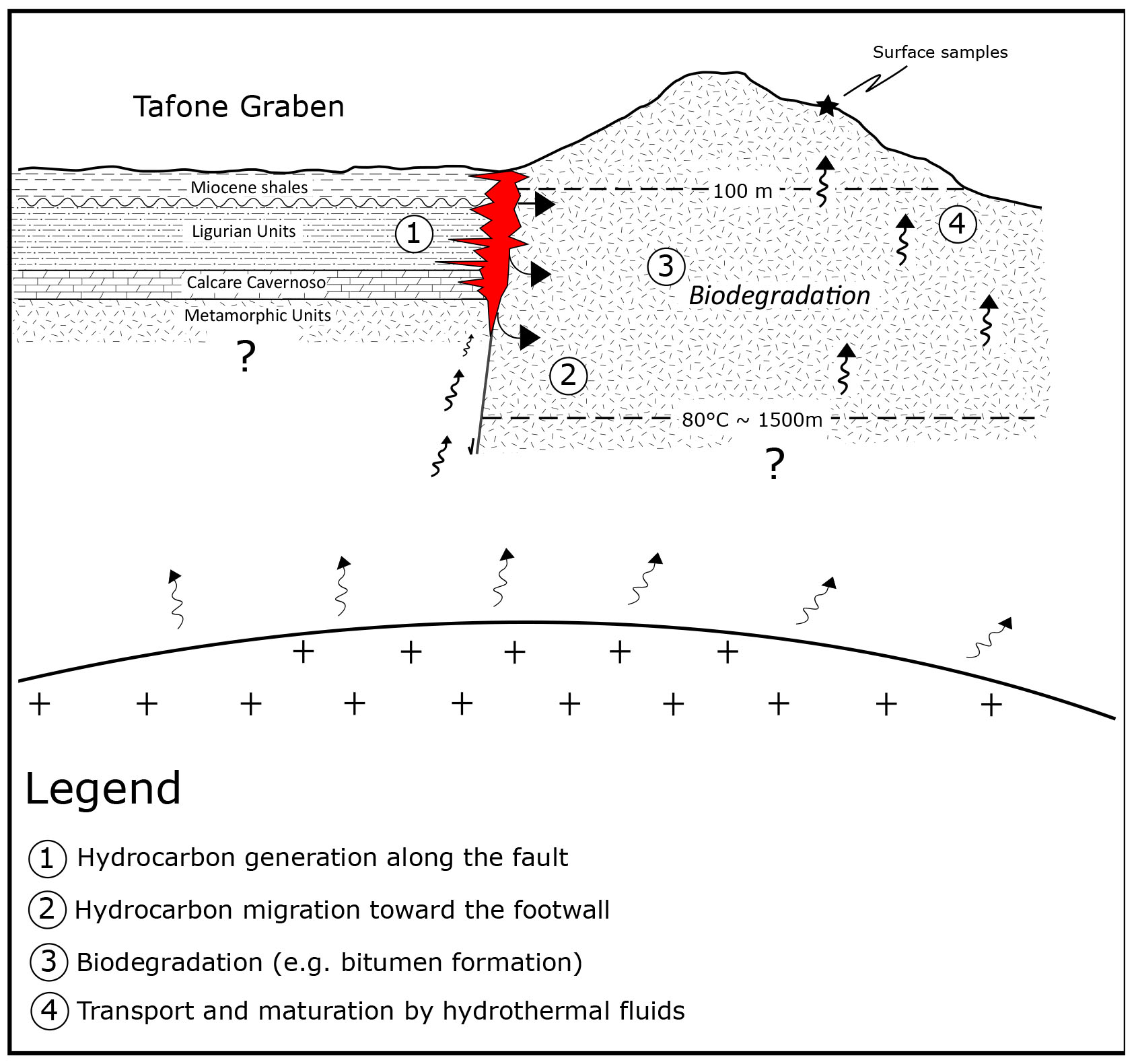
After migration, oil was degraded by microbial activity as testified by the presence of 25-norhopanes. 25-norhopanes form through the microbial removal of the methyl group at C-10 from hopanes during biodegradation. This is a temperature-controlled process that occurs in anaerobic burial conditions, thus perhaps below 100 m depth and was never found to occur at temperatures higher than 80 °C (Wilhelms et al., 2001). Considering the present day geothermal gradient of 50 °C/km (Della Vedova et al., 2001), this means that biodegradation occured to a depth of about 1500 m as shown in Fig. 7. Both degraded and not hydrocarbon were finally brought to the surface during one last hydrothermal pulses (Fig. 7).
It is worth to state that, as an alternative hypothesis to justify the presence of bitumen in the Amiata region, Rimondi et al. (2015) propose the presence of an underlying organic-rich shale. Nevertheless, we have any knowledge of carbon-rich shales below the Tuscan or metamorphic series. Moreover, this interpretation, imply a questionable allochtonous origin of the metamorphic units that, perharps in the nearby Amiata region are known to be autoctonous by deep drilling for geothermal purposes (Carmignani et al., 1994; Brogi, 2008).
Implication for the Southern Tuscany ore district
The association of hydrocarbons with ore deposits is a wordwide recognized phenomenon (Parnell, 1993). In particular, it was demonstrated that in hydrothermal environments, liquid hydrocarbons, bitumen and the remaining kerogen can act as strong reducing agents during ore (in particular sulphides) mineralization (Peabody, 1993). The Tafone Basin hosts important stibnite deposits along the faults that border the graben at the contact between the basement rocks with the limestones and dolostones of the Tuscany series. The results from this work highlight that the hydrocarbons circulated in the basement rocks during hydrothermal activity and thus could have played a key role in the sulphide mineralization of the area.
Interestingly, several authors report the presence of solid hydrocarbons in the Mt. Amiata region (Arisi Rota & Vighi, 1971; Rimondi et al., 2015) that is one of the main ore district in Southern Tuscany, suggesting they could have contributed to the mineralization process. The origin of such bitumen has never been explained, so the model provided in this work could be tentatively exported to similar areas.
CONCLUSIONS
We report the occurrence of hydrocarbons in hydrothermally altered metamorphic rocks of Monti Romani in Southern Tuscany. The association of amorphous carbon and hydrocarbons with high temperature fluid inclusions in mineralized veins suggests a hydrothermal origin for the hydrocarbons. The presence of 25-norhopanes shows that microbial biodegradation occurred at depth in the basement rocks, confirming that hydrocarbon-bearing basement rocks can be a favourable habitat for microbial activity (Marynowski et al., 2011; Parnell et al., 2017).
The genetic model for hydrothermal generation and migration of hydrocarbons proposed in this work could explain the presence of hydrocarbons in others geothermal areas of Southern Tuscany which may have played a role in ore mineralization.